Recently, renowned French screenwriter Olivier Lorelle visited our university as a special guest. Mr. Lorelle has received two Academy Award nominations, and his works have won the prestigious Palme d'Or at the Cannes Film Festival. During his visit, he engaged in in-depth exchanges with our faculty and students through screenwriting workshops, keynote lectures, and roundtable discussions, bringing cutting-edge international creative concepts and offering a masterclass in high-level film and television production.
The event aimed to encourage students to create works that combine national characteristics with global appeal, while also serving as a bridge for East-West cultural exchange in film and television. It further supported our faculty and students in broadening their international perspectives and enhancing their creative capabilities.
Screenwriting Workshop: Artistic Breakthroughs Through Professional Mentorship
The five-day screenwriting workshop attracted great attention across campus. After a rigorous selection process, the authors of 50 outstanding scripts from the “Youth Cup” Screenplay Competition were invited to participate and receive one-on-one professional guidance from Mr. Lorelle.
Adhering to the core principles of “forward-thinking and internationalization,” Mr. Lorelle gave detailed feedback and patient instruction on each script's story arc, character development, and conflict design. Through his comprehensive and systematic approach, the quality of the scripts was significantly improved. Both students and faculty praised the workshop as “rich in practical value.”
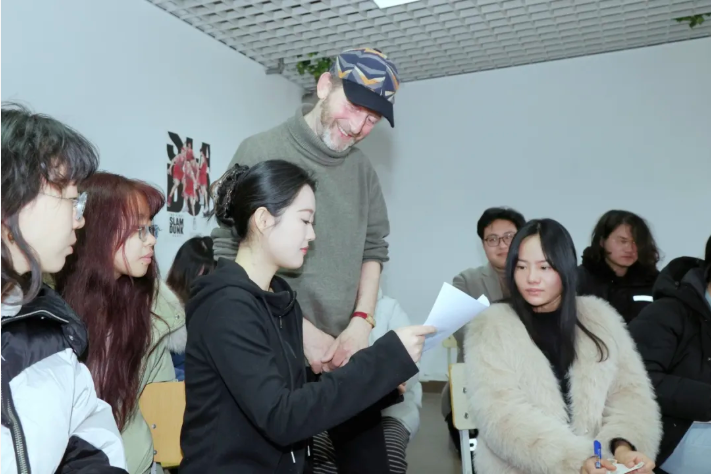
Workshop in session
Keynote Lecture: The “Three Elements” of Storytelling

Olivier Lorelle’s Lecture
In his keynote lecture, Mr. Lorelle offered a unique perspective that merges philosophy with screenwriting. He delved deeply into the roles of conflict, desire, and suspense in storytelling. Tracing the historical development of drama, he proposed three essential elements of scriptwriting:
A central action that drives the entire narrative,
A clear and unwavering narrative direction,
Strong conflicts that effectively propel the plot.
He compared the use of suspense in commercial films and art-house cinema, encouraging writers to master the art of leaving things unsaid. “Not every detail needs to be spelled out,” he explained. “Audiences enjoy figuring things out for themselves.” He also urged students to break free from conventional frameworks, stating: “Greek tragedies laid the foundation for dramatic storytelling, and Hollywood standardized those rules—but we shouldn’t be confined by them. True creativity is born from the collision and interplay of emotion and reason.”
Roundtable Discussion: Exploring Filmmaking in a Global Context
Mr. Lorelle joined our faculty in a roundtable discussion on the integration of global expression with local cultural identity. He emphasized that film is both a vivid reflection of regional cultures and a universal language of human emotion. He shared insights on what makes a successful international film—namely, a clear theme, concise narrative, and powerful cross-cultural resonance. He also offered his views on topics such as how Chinese mythology can reach global audiences.
Using the story of Nezha cutting his flesh for his parents as an example, he stressed that the essence of a compelling story lies in conflict and struggle, and that its logical framework must be rigorous and coherent.
Addressing the rapid development of AI, he remarked that while AI may serve as a creative tool, it can never truly replace human sensitivity to life’s emotional subtleties. Comparing film education in France and the United States, he concluded that one must dare to innovate beyond traditional thinking while still maintaining respect for classic works and traditional creative values.

Roundtable discussion in progress
As Mr. Lorelle aptly stated: “Film is a language that transcends borders. Every act of creation should be an adventure into the unknown.”
Jilin Animation Institute remains committed to its distinctive model of open and international education. With an inclusive and outward-looking approach, the university is actively nurturing a new generation of talent in film and television, striving to tell compelling Chinese stories on the global stage. Looking ahead, the school will continue to hold regular international exchange events, helping students stay at the forefront of the industry and produce outstanding creative works.