Alumni are invaluable assets of Jilin Animation Institute. Their professional experience, career journeys, and life insights serve as inspiration and guidance for current students. Within the big family of Jilin Animation Institute, a steady stream of outstanding alumni has emerged, achieving remarkable accomplishments in their respective fields and embodying the core "Four Innovations" culture of "innovation, creation, excellence, and entrepreneurship" through their practical actions.The school has launched the "TA Says · Alumni Season" series of interview reports, where outstanding alumni share their personal experiences, career development in employment and entrepreneurship, as well as advice for their younger schoolmates. We now extract the core parts of these sharing sessions to present to readers.
In the field of game art design, Jin Yu is a seasoned practitioner. With 13 years of experience as a concept artist, she has participated in well-known projects such as Bloodborne, Mobile Legends: Bang Bang, and UFC. She has worked at major companies including EA, ByteDance (MoonToon), and Bron Studio, and currently holds the position of Chief Concept Artist at Syncarnation in Vancouver. Recently, she returned to her school, Jilin Animation Institute, to attend an event and shared her growth insights regarding her academic and professional journey.
Campus Memories: The Long-Term Impact of Classroom Techniques and Professional Knowledge
During her academic years at Jilin Animation Institute, the Scene Design course left a deep impression on Jin Yu. This course focused on the artistic expression of natural objects, particularly the depiction of different types of clouds in animation shots. She engaged in extensive practice at that time, and the techniques she learned then are still applied in many of her current concept art designs.
Among the professional knowledge acquired in university, the Game Character Design course proved to be the most beneficial for her. Taking the creation of Bloodborne as an example, its art style emphasizes the cultivation of mood and atmosphere. When she was responsible for designing minor bosses, she enhanced the sense of oppression and conveyed the background story through details such as character shadows, textures, and rendering, using visuals to "narrate" the characters' experiences. It was the knowledge and skills accumulated from the university's Character Design course that enabled her to successfully complete this task.
Professional Experience: From Mindset Transformation to Cross-Cultural Design Practice
From working at a game company in Shanghai to joining EA and ByteDance, the diverse work styles and cultural connotations of these different enterprises have driven Jin Yu through numerous transformations. The Shanghai-based company prioritized efficiency and execution; EA placed great emphasis on processes, documentation, and team collaboration; while ByteDance highlighted data-driven approaches and user feedback. These experiences compelled her to break free from the "single-dimensional artistic mindset" and develop a "product-oriented mindset" — design is no longer merely a form of self-expression, but a service for the user experience, the audience, and the market. Her career plan has also shifted from focusing solely on artistic roles to creative management roles involving cross-departmental collaboration.
When tackling global projects like UFC and Fortnite, her design secret lies in first defining a basic style that is universally accepted, such as the realistic style adopted in UFC; then incorporating local elements tailored to different regions, such as traditional Chinese New Year-themed player cards for the Chinese market, and Christmas and Halloween-themed content for Western markets. At the same time, it is necessary to remain vigilant about cultural sensitivities. When necessary, consulting local advisors and optimizing designs based on data ensures that players from all regions can feel the dedication of the creators.
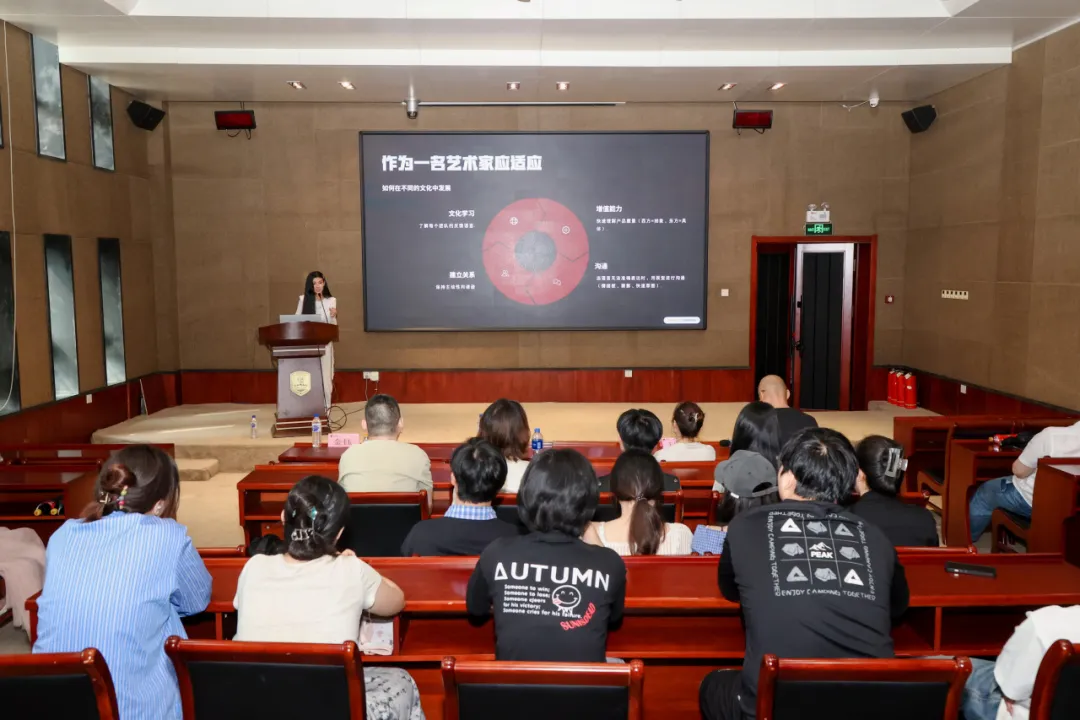
Jin Yu delivered a lecture at the school
Industry Outlook: Emerging Professions Likely to Emerge in the Next 5 Years
Having witnessed market changes over her 13-year career, Jin Yu believes that new professions will emerge in the game art industry in the next 5 years. For instance, the role of AI Art Tool Optimizer — which goes beyond mere image generation to guiding AI models in producing high-quality assets; and the role of Art Data Analyst — who optimizes art strategies based on retention rates, click-through rates, and user behavior data. She notes that such positions are already showing signs of emergence in major companies. While the market and technology are constantly evolving, individuals who "can integrate technology, understand players, and tell compelling stories through visuals" will always be the most in demand.
Advice for Younger Schoolmates: Cultivate Key Mindsets and Avoid Growth Pitfalls
Jin Yu believes that during the four years of university, students should focus on cultivating three key abilities: first, a structured mindset — before starting a design, one should clearly ask "why am I doing this", "who is the target audience", and "is the logic sound"; second, cross-disciplinary communication skills — throughout one's growth journey, it is inevitable to interact with programmers, planners, and marketing personnel, and one cannot only rely on saying "I think this looks good"; third, an international perspective and cultural understanding — the more international a project is, the greater the need for talents who can tell stories across different cultures.
She also reminds younger schoolmates not to always seek "shortcuts", not to rely on imitation or template application, not to over-depend on AI, and not to only watch tutorials without engaging in hands-on practice. Those who can achieve long-term success are always those who are down-to-earth, think deeply, and are willing to invest time in accumulating experience.